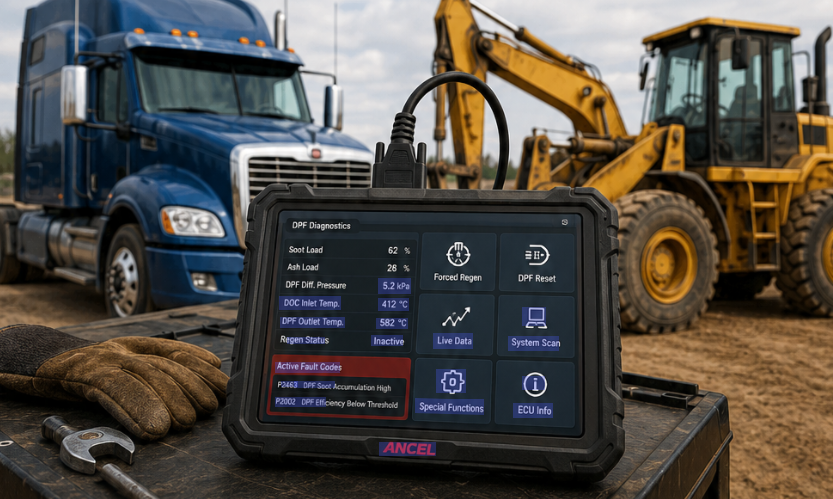
A heavy-duty DPF scanner must do more than read fault codes. It should communicate with the correct engine control module, display aftertreatment data, identify faults that may prevent regeneration, and support the required forced regeneration or DPF reset procedure.
For mixed fleets, the Foxwell HD500 and TOPDON ArtiDiag HD provide broad truck coverage. The ANCEL HD3600 is better suited to construction, agricultural, and other off-highway equipment. The ZURICH ZRHD1 is a simpler option for North American truck owners who mainly need fault codes, live data and selected DPF regeneration functions.
However, no heavy-duty scanner supports every DPF procedure on every engine. Compatibility depends on the vehicle manufacturer, engine model, ECM version, model year, emissions configuration, diagnostic connector, and installed scanner software.
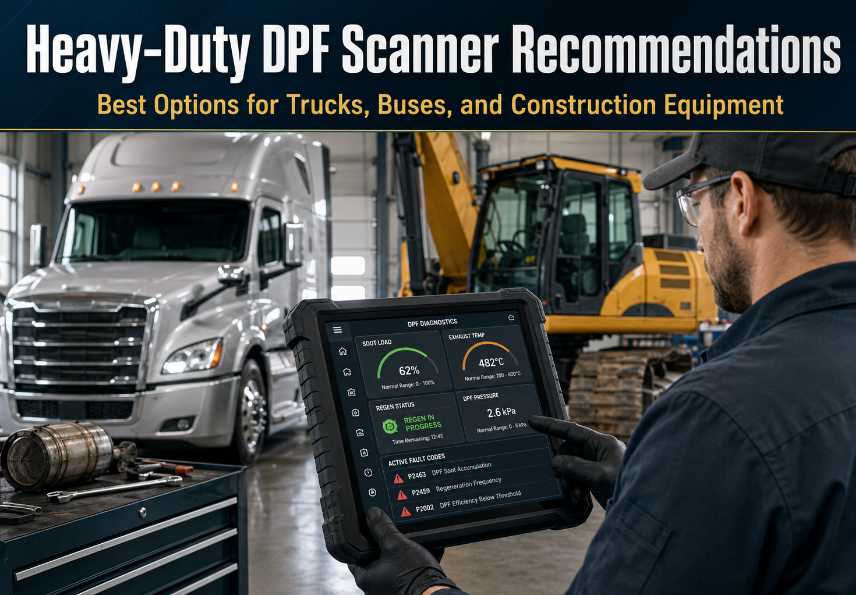
Heavy-Duty DPF Scanner Recommendations at a Glance
| Diagnostic scanner | Best suited for | Main DPF and diagnostic functions |
|
Foxwell HD500
|
Mixed fleets, trucks and buses | Forced DPF regeneration, full-system diagnostics, live data, injector cutoff, active tests and speed-limit functions |
|
ZURICH ZRHD1
|
North American owner-operators and small fleets | Fault-code reading, live data and DPF regeneration on selected engines |
|
ANCEL HD3600
|
Construction, agricultural and off-highway equipment | DPF regeneration, DPF reset, engine diagnostics and broader equipment coverage |
|
TOPDON ArtiDiag HD
|
Fleet managers and mobile diesel technicians | DPF regeneration, SCR reset, urea-drive reset, injector coding and full-system diagnostics |
|
ANCEL HD8000
|
Professional truck workshops | DPF regeneration and reset, topology mapping, all-system diagnostics and advanced service functions |
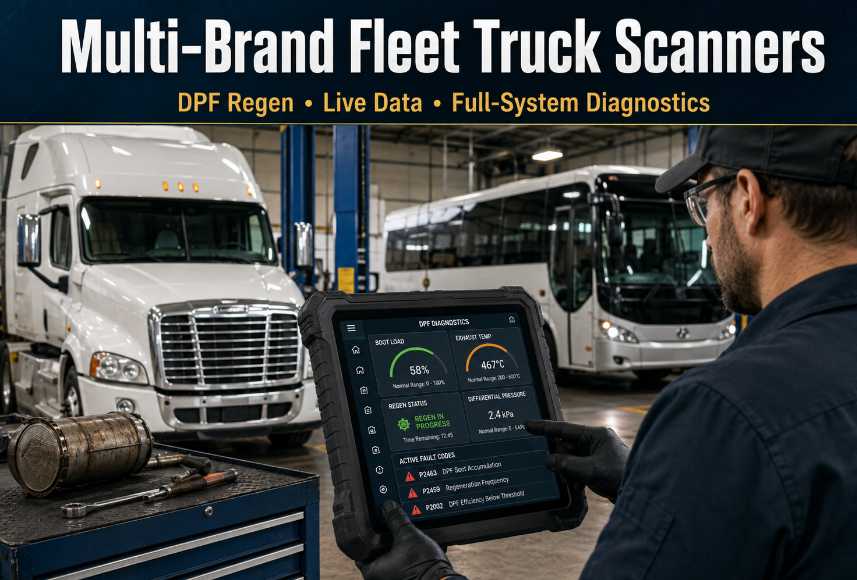
What Should a Heavy-Duty DPF Scanner Support?
Modern commercial trucks commonly communicate through SAE J1939, while older trucks may require SAE J1708 and J1587 support. A useful multi-brand scanner should also include the appropriate 6-pin, 9-pin, 16-pin or manufacturer-specific adapter for the vehicles being serviced.
Connector compatibility alone does not confirm diagnostic coverage. For example, a scanner supplied with a Caterpillar 9-pin cable may communicate with supported Caterpillar equipment without providing every Caterpillar Data Link or Cat ET function. Caterpillar identifies CDL and J1939 as distinct communication systems in some applications, so buyers should verify the exact engine, ECM and service routine before ordering.
The most useful DPF scanner should provide access to:
- Active and stored aftertreatment fault codes
- DPF differential pressure
- Inlet and outlet exhaust temperatures
- Calculated soot load
- Regeneration status
- Forced or parked regeneration
- DPF replacement or cleaning reset
- SCR and DEF system data
- Regeneration inhibition reasons
The available functions will vary by engine and software version.
1. Foxwell HD500: Best for Mixed Truck Fleets
The Foxwell HD500 is designed for pickups, commercial trucks and buses from manufacturers and engine families such as Caterpillar, PACCAR, International, Detroit and Hino.
It supports full-system scanning, fault-code reading and clearing, live-data monitoring, active tests and selected service functions. Published functions include DPF regeneration, injector cutoff and speed-limit adjustment. Foxwell also lists support for protocols including J1939, J1708, J1587 and several automotive OBD standards.
Why choose the Foxwell HD500?
- Suitable for mixed-brand on-highway fleets
- Supports forced DPF regeneration on compatible engines
- Displays live aftertreatment data.
- Provides full-system diagnostics
- Includes active-test and injector-cutoff capabilities
- Uses an Android-based touchscreen interface
The HD500 is a practical choice for fleet technicians who need more than a basic code reader but do not require dealer-level programming software.
Important: DPF functions differ by engine, year and ECM. Check the Foxwell coverage information for the exact vehicle before purchasing.
2. ZURICH ZRHD1: Practical Option for North American Trucks
The ZURICH Heavy Duty Truck Code Reader with DPF Regen, also identified as the ZRHD1, is intended primarily for North American commercial trucks and tractors.
It can read and clear generic trouble codes, display live data and perform DPF regeneration on selected Caterpillar, Cummins, Detroit, Hino, International, Isuzu, MaxxForce, Mack, PACCAR and Volvo applications. It supports J1587, J1708, J1939 and OBD2/CAN protocols.
The package includes:
- 6-pin heavy-duty connector
- Type II 9-pin connector
- Caterpillar 9-pin connector
- Standard 16-pin OBD2 connector
Who should consider it?
The ZURICH scanner is most appropriate for owner-operators, small fleets and mobile technicians who primarily need code reading, live data and forced regeneration.
It is less suitable for workshops requiring broad bi-directional testing, advanced calibrations, parameter programming or deep diagnostics across numerous vehicle systems.
3. ANCEL HD3600: Best for Construction and Off-Highway Equipment
The ANCEL HD3600 Heavy Equipment Diagnostic Tool is the strongest option in this group for technicians who regularly service construction machinery, agricultural equipment and off-highway vehicles.
ANCEL lists DPF regeneration support for selected Caterpillar, John Deere, Volvo, Bobcat and Komatsu equipment. The tool can also diagnose supported trucks and includes OBD2, heavy-duty 6/9-pin and Caterpillar 9-pin connections.
Main ANCEL HD3600 functions
- Forced DPF regeneration
- DPF reset on supported applications
- Fault-code reading and clearing
- ECU identification
- Live-data display and recording
- Data-stream graphing and comparison
- Engine and selected full-system diagnostics
- Diagnostic report and screenshot storage
The HD3600 is particularly useful for workshops that service excavators, loaders, tractors, dozers and trucks rather than only highway vehicles.
Important limitation
The HD3600 should not automatically be described as supporting every soot-ratio or ash-accumulator reset on every listed brand. Its published coverage confirms DPF regeneration and reset functions, but the exact routine depends on the machine, engine and controller software.
Verify the following before ordering:
- Machine manufacturer and model
- Machine model year
- Engine manufacturer and model
- ECM or ECU identification
- Diagnostic connector type
- Required function, such as forced regeneration, DPF replacement reset or ash reset
4. TOPDON ArtiDiag HD: Best for Broader Emissions-System Service
The TOPDON ArtiDiag HD provides full-system coverage for more than 60 medium- and heavy-duty brands. Its service functions include DPF regeneration, SCR reset, urea-drive reset and oil reset.
It also supports selected advanced procedures such as:
- Injector coding
- Idle-speed adjustment
- Clutch matching
- Speed-limit reset
- Live-data graphing
- Freeze-frame analysis
- Automatic diagnostic reports
The ArtiDiag HD is a strong option for mobile diesel technicians and fleet workshops that encounter both DPF and SCR-related problems.
Its SCR and urea-drive functions may be especially useful when a vehicle remains derated after an aftertreatment repair. However, the scanner cannot override an unresolved sensor, wiring, DEF-quality or aftertreatment fault. The original problem must be diagnosed before the reset or regeneration procedure can be completed successfully.
5. ANCEL HD8000: Best for Professional Truck Workshops
The ANCEL HD8000 is a higher-level diagnostic platform intended for professional heavy-duty truck service.
Published functions include:
- DPF regeneration and DPF reset
- Full-system diagnostics
- ABS and transmission reset
- Speed-limit adjustment
- Idle-time adjustment
- Topology mapping
- Automatic diagnostic-pin detection
- Simultaneous live-data monitoring
- Special functions and calibration procedures
The HD8000 supports J1939, J1708/J1587, ISO 27145 and several automotive diagnostic protocols. It also includes multiple adapters for Cummins, Volvo, Isuzu, Hyundai and standard heavy-duty applications.
This tool is more appropriate for workshops that need broader system access and faster vehicle-wide diagnosis rather than a scanner used only for occasional DPF regeneration.
DPF Regeneration vs. DPF Reset: What Is the Difference?
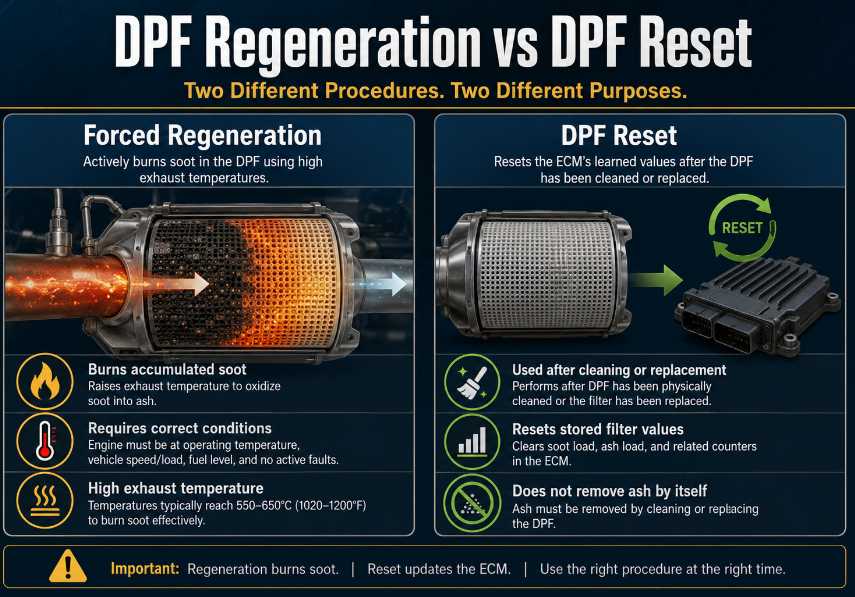
These two functions should not be treated as interchangeable.
Forced DPF regeneration
Forced regeneration raises exhaust temperature to burn accumulated soot inside the filter. It may be required when normal passive or automatic regeneration has not reduced the soot load sufficiently.
DPF reset
A DPF reset updates or clears calculated filter information stored in the ECM. Depending on the manufacturer, it may be required after:
- Removing and professionally cleaning the DPF
- Replacing the DPF
- Replacing an aftertreatment control module
- Replacing a differential-pressure sensor
- Completing another manufacturer-specified repair
Regeneration burns soot, but it does not remove all accumulated ash. A severely ash-loaded filter may need to be removed for inspection, professional cleaning or replacement before the correct DPF reset is performed.
Do not perform a DPF reset to turn off a warning light. Resetting calculated values without completing the required repair can produce inaccurate soot or ash calculations and may contribute to another derate.
Why Can a Forced Regeneration Fail?
A scanner cannot force the ECM to complete regeneration when the engine’s safety conditions are not met.
Common reasons for a failed or unavailable regeneration include:
- Active aftertreatment fault codes
- Faulty exhaust-temperature sensors
- Incorrect differential-pressure readings
- Damaged DPF pressure hoses
- Exhaust leaks
- EGR or turbocharger problems
- Insufficient engine temperature
- Low fuel or DEF level
- PTO or cruise control still active
- Parking brake not applied.
- Excessive soot or ash loading
Before starting regeneration, diagnose active engine and aftertreatment faults and verify the scanner’s displayed regeneration prerequisites.
Forced DPF Regeneration Safety
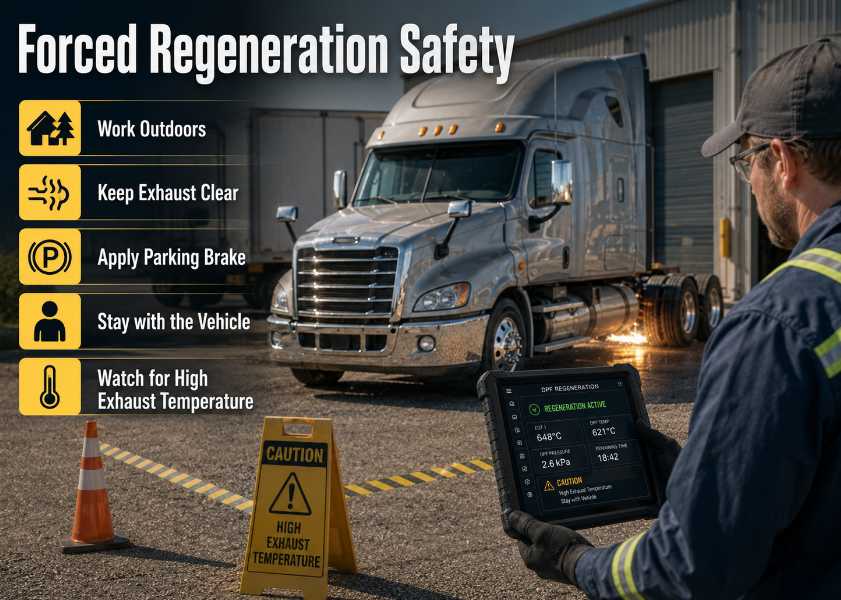
Forced regeneration produces extremely high exhaust temperatures. Perform the procedure outdoors, keep the exhaust outlet away from combustible materials and confirm that there are no fuel or oil leaks near the exhaust system.
The vehicle should remain stationary with the parking brake applied. Do not leave the truck or machine unattended while regeneration is running. ANCEL’s published guidance recommends clearing obstructions within 10 feet of the exhaust outlet and confirming that no active aftertreatment faults are present.
Always follow the vehicle manufacturer’s service instructions and the on-screen scanner prompts.
Which Heavy-Duty DPF Scanner Should You Choose?
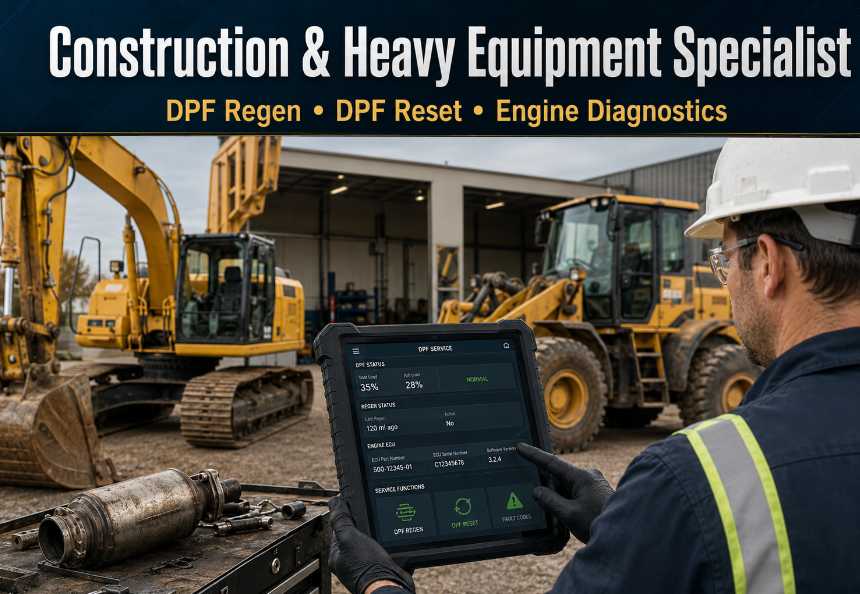
Choose the scanner according to the equipment you service most often:
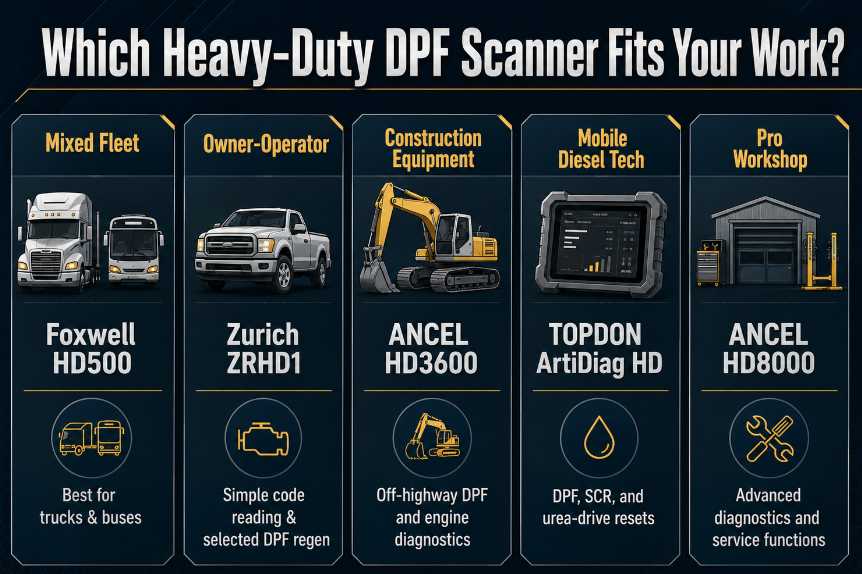
- Mixed highway truck fleet: Foxwell HD500
- Owner-operator or small North American fleet: ZURICH ZRHD1
- Construction and agricultural machinery: ANCEL HD3600
- DPF, SCR and DEF-related service work: TOPDON ArtiDiag HD
- Professional full-system truck diagnostics: ANCEL HD8000
The best scanner is not necessarily the model with the longest feature list. It is the scanner that supports the exact vehicle, engine, ECM and DPF procedures in your workshop.
Before purchasing, provide the seller with the vehicle identification number when available, along with the manufacturer, model, year, engine model and required service function. Written compatibility confirmation can prevent purchasing a scanner that reads fault codes but cannot initiate the required regeneration or reset procedure.
Frequently Asked Questions
Can every heavy-duty scanner perform a forced DPF regeneration?
No. Some scanners only read generic DPF fault codes and live data. Forced regeneration requires manufacturer- and engine-specific software support.
Does a 9-pin connector guarantee DPF regeneration support?
No. The connector only provides a physical connection. The scanner must also contain compatible software for the engine, ECM and required regeneration command.
Can forced regeneration clean ash from a DPF?
Forced regeneration primarily burns soot. It does not completely remove noncombustible ash. A filter with excessive ash may require removal, professional cleaning or replacement.
Should the DPF be reset after cleaning?
A reset may be required after professional cleaning or replacement, depending on the engine manufacturer’s service procedure. Do not perform the reset until the physical service has been completed.
Can a scanner remove an engine derate?
A compatible scanner may perform required regeneration or aftertreatment resets, but it cannot safely remove a derate while the underlying fault remains active. Sensor, wiring, exhaust, DEF and engine problems must be repaired first.